
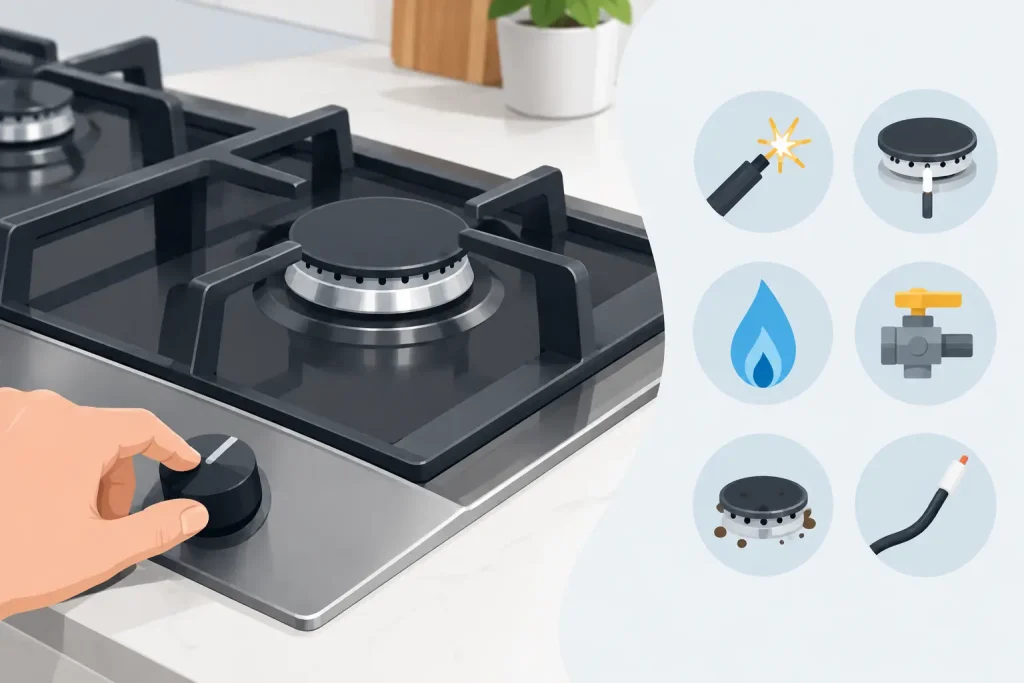
A gas hob that will not light can stop dinner plans in minutes, but the cause is not always a serious one. Common gas hob ignition faults often come down to moisture, food debris or a burner cap that has been replaced slightly out of position. Other symptoms, particularly repeated clicking, no spark across every burner or a smell of gas, need a more cautious response.
The useful distinction is between a problem with the spark and a problem with the gas reaching or lighting at the burner. Knowing what you are seeing helps you take sensible first steps, avoid unsafe DIY repairs and decide when to arrange an engineer.
How a gas hob ignition system works
When you turn and press a control knob, the ignition system sends a high-voltage spark to the small ceramic electrode beside the burner. At the same time, gas flows to the burner. If the burner cap and crown are correctly fitted, the spark lights the gas and a flame should form promptly and evenly around the ring.
Most hobs share an ignition module, although each burner has its own electrode. That is why one faulty burner can point to a local issue, while a fault affecting every burner may suggest a problem with the power supply, ignition controls or module. The exact diagnosis depends on the hob model and the symptoms, not simply on whether it clicks.
Common gas hob ignition faults by symptom
The burner clicks but will not light
This is one of the most frequent calls. If you can hear a steady clicking sound but see no flame, start by allowing the hob to cool completely. Remove the pan supports, burner caps and burner crowns if they are designed to lift away, then check for spilled food, grease or water around the electrode and burner ports.
A damp electrode can allow the spark to track in the wrong direction rather than jumping to the burner. Cleaning with a soft, dry cloth and leaving the parts to air-dry thoroughly can help. Do not use a metal pin, abrasive cleaner or excessive water around the ignition point. These can damage the electrode or push debris further into the burner ports.
Before trying again, refit every part carefully. A burner cap that looks almost right can still sit unevenly, leaving the spark too far from the metal surface or preventing gas from distributing correctly. If the burner still clicks but will not light once clean and dry, the electrode, ignition lead, burner assembly or gas control may require professional attention.
One burner will not spark, but the others work
When the other burners ignite normally, the power supply and main ignition module may be working. The likely issue is closer to that individual burner: a dirty or cracked electrode, a loose connection, damage to the ignition lead, or a burner cap and crown that are not correctly seated.
Look for obvious residue and make sure the ceramic electrode is dry. It should not be wobbly, chipped or heavily stained. A cracked electrode may still produce an occasional spark, but it can become unreliable when the hob is warm or humid. Replacement is normally a straightforward repair for the correct engineer, but the hob should not be dismantled by an unqualified person.
The hob keeps clicking after the flame is lit
Continuous clicking is irritating, but it also deserves attention. It commonly happens after boiling water over, wiping the hob while it is still warm, or cleaning around the controls. Moisture can reach an electrode or the ignition switch beneath a knob and keep the circuit active.
Turn the controls off, allow the hob to cool and dry the burner area carefully. If the hob plugs into a socket that you can safely access, switch it off at the socket before cleaning or drying the surface. Do not remove panels or attempt to dry internal components with heat.
If clicking continues after the hob has dried, or starts again without any spill, arrange a repair. A sticking ignition switch or failing ignition module can make the hob unpredictable and may worsen over time.
There is no clicking or spark from any burner
No clicking across the whole hob is a different pattern. First, check whether the hob has power, where appropriate. Some models plug into a switched socket, and a simple switch-off can be mistaken for a major appliance failure. If the hob shares a switched outlet with another appliance, avoid overloading it and only make basic external checks that are safe and accessible.
If power is present but no burner clicks, the fault could be in the ignition module, the control switches or internal wiring within the appliance. This is not a repair to attempt yourself. A qualified appliance engineer can test the components safely and confirm whether repair is economical for the age and condition of the hob.
There is a spark, but the flame is weak or uneven
A visible spark does not guarantee a healthy burner. If the gas lights but the flame is patchy, yellow-tipped, lifting away from the burner or only appearing on one side, the burner ports may be blocked or the parts may be misaligned. Grease and cooking residue are common causes, especially on the burners used most often.
Once the hob is cool, clean removable burner components in line with the manufacturer guidance, dry them fully and refit them precisely. Never enlarge burner holes or scrape at gas jets. If the flame remains irregular, switch the burner off and book an inspection. Poor combustion is not something to ignore, even if the hob still lights.
The burner lights only with a match or lighter
If gas is reaching the burner and it lights using a manual flame, the ignition system is likely at fault rather than the gas supply. However, this is not a reason to carry on using the hob indefinitely. Using a match or lighter repeatedly puts your hand close to an unlit gas burner and can mask a fault that is becoming more serious.
A short-term test may help an engineer understand the symptom, but do not use a naked flame if you can smell gas, if the burner is flooding with gas, or if the hob has been behaving erratically. Turn the control off and seek advice instead.
Safe checks you can make before booking a repair
For many households, the sensible limit is checking the obvious external causes. Make sure the burner caps are in the right position, remove loose debris once the hob is cold, and allow any recent spill to dry fully. If only one burner is affected, compare how its cap and crown sit against a working burner.
Avoid taking apart control knobs, lifting the hob from the worktop or trying to repair electrodes and gas components. A gas hob combines gas, ignition voltage and heat. What appears to be a small loose part may be connected to components that need safe testing and correct reassembly.
It is also worth noting the pattern before you call: whether the issue affects one or all burners, whether it began after a spill, whether there is clicking, and whether a flame forms at all. These details can speed up diagnosis and help ensure the right parts are considered.
When to stop using the hob immediately
Turn the hob off and do not attempt further ignition if you smell gas, hear a hissing sound, see a damaged burner or control, or notice flames behaving unusually. If it is safe to do so, turn off the gas supply at the isolation valve for the appliance. Open doors and windows, avoid flames or smoking, and do not operate electrical switches in the area.
If you suspect a gas leak, contact the National Gas Emergency Service on 0800 111 999. For a hob fault without a suspected leak, a qualified engineer can identify whether the problem is confined to ignition components, burner parts or the gas controls.
Getting a dependable repair in North London
An intermittent hob fault is easy to put off until it becomes a complete failure at the worst possible time. Prompt diagnosis is usually the practical option, particularly for landlords and households relying on the hob every day. D C N Hinds Limited provides responsive gas hob repair support across North London and nearby areas, with clear advice on the fault and a free quotation before work proceeds.
If your hob is clicking constantly, failing to spark or lighting unevenly, stop guessing at the cause. A careful inspection can restore safe, reliable cooking and give you confidence each burner is operating as it should.
