
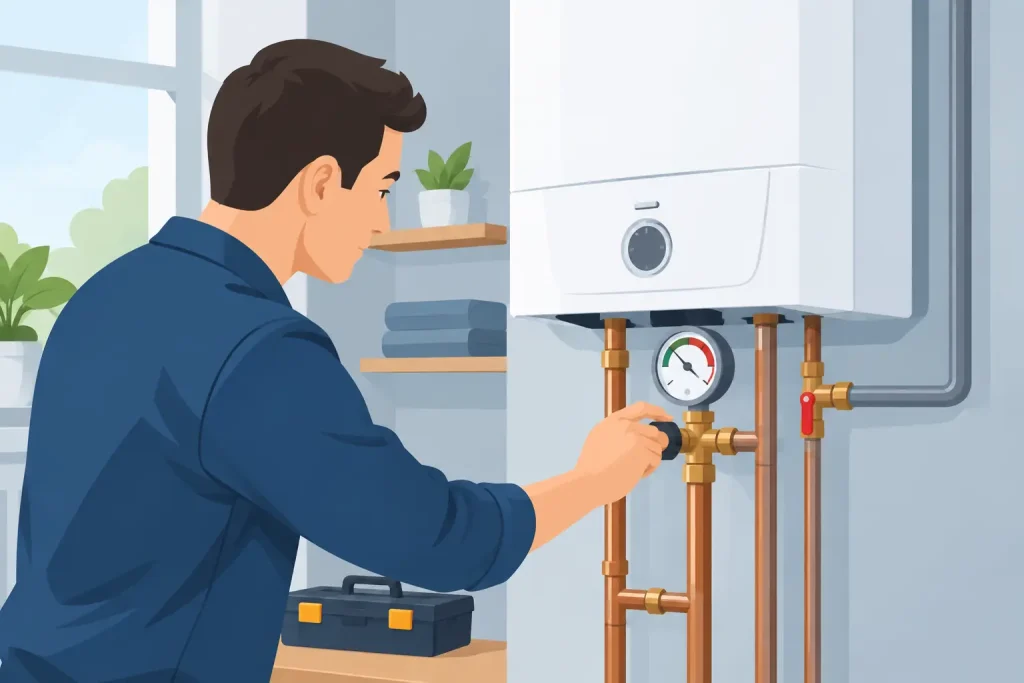
A boiler pressure warning often appears at the worst possible time: when the heating is due to come on, the shower has gone cold, or a tenant has reported a fault. The good news is that learning how to reset boiler pressure is often straightforward on a modern sealed heating system. The important part is knowing the correct pressure, filling the system slowly, and recognising when low pressure points to a fault that needs an engineer.
What boiler pressure should be
Most domestic boilers work best at around 1 to 1.5 bar when cold. Your boiler may show the reading on a round pressure gauge, a digital display, or both. The exact recommended level can vary slightly by manufacturer, so check the instructions printed inside the boiler flap or in its manual if available.
When the heating is running and the system is hot, the pressure normally rises. A reading around 1.5 to 2 bar can be perfectly normal at this point. What matters is that it does not climb close to 3 bar, where the boiler may discharge water through its safety valve.
If the gauge is below 1 bar when the system is cold, many boilers will display a fault code or stop operating to protect themselves. Repressurising may restore the heating and hot water, but it is not always the complete answer. Pressure that repeatedly falls usually means water is escaping somewhere or there is an issue inside the boiler.
How to reset boiler pressure using the filling loop
Before starting, turn the boiler off and allow it to cool if it has been running. This gives you a more accurate cold pressure reading and avoids handling pipework that may be hot. Do not remove the boiler casing or interfere with internal parts.
Your boiler will usually have one of two filling arrangements: an external braided filling loop beneath the boiler, or an internal filling key or lever built into the underside of the appliance. If you cannot identify the filling mechanism with confidence, stop there and arrange professional help. Forcing the wrong valve can cause a leak or over-pressurise the system.
External filling loop
An external filling loop is commonly a short, flexible silver hose connecting two pipes beneath the boiler. It normally has a small valve at each end. In some homes the hose is permanently fitted; in others, it is stored separately and only attached when needed.
First, place a towel below the pipework in case of a small drip. Make sure the filling loop is securely connected if it is removable. Then open both valves gradually. You should usually hear water moving into the system.
Watch the pressure gauge throughout. Once it reaches around 1 to 1.5 bar, close both valves fully. Do not leave the filling loop open after topping up, even if the pressure seems slow to rise. Leaving it open can lead to excess pressure and water discharge.
Internal filling key or filling lever
Many newer boilers have a built-in filling arrangement rather than a visible hose. This may involve inserting and turning a plastic key, then opening a small lever or tap. Other models have a simple filling valve that turns by hand.
Follow the instructions displayed on or beneath the boiler where possible. Open the filling control slowly and keep an eye on the gauge or display. Stop at the cold pressure recommended for your model, then return the key, lever or valve to its closed position.
Never guess if the controls are unclear. Boiler layouts differ considerably, and a quick check by a qualified heating engineer is safer than damaging a valve or allowing the system to overfill.
What to do after repressurising
Once the pressure is back in range, switch the boiler on and allow it to run normally. Check that the fault code has cleared and that heating and hot water return. It may take a little time for radiators to warm up fully.
Recheck the gauge after the system has heated up, then again once it has cooled. A modest rise while hot is expected. However, if it rises towards 2.5 or 3 bar, or water starts dripping from an external copper discharge pipe, turn the heating off and arrange an engineer visit.
It is also worth looking around visible radiator valves, pipe joints and beneath the boiler for signs of water. A tiny ongoing leak can be enough to lower pressure over days or weeks, even when there is no obvious puddle.
When low boiler pressure is more than a simple reset
Topping up the pressure once after radiators have been bled or after a long period without use can be normal. Repeatedly needing to refill the system is different. It should be investigated rather than treated as a routine household job.
Common causes include a leaking radiator valve, a small leak in heating pipework, a faulty pressure relief valve, or a problem with the boiler’s expansion vessel. Some faults are visible, but many are not. Pipework may run beneath floors, inside walls or through cupboards, while a boiler fault requires safe diagnosis by a competent engineer.
Do not keep adding water every few days to get the heating working. Fresh water introduces oxygen and minerals into the system, which can contribute to internal corrosion and sludge over time. More importantly, a persistent pressure loss may become a larger leak or a boiler breakdown if left untreated.
Avoid these common mistakes
The most common error is overfilling. Pressure can rise quickly, particularly if both filling valves are opened fully. Fill slowly and stop at the correct cold reading. If you accidentally take the pressure above 2 bar while the boiler is cold, do not ignore it or assume the boiler will sort itself out.
Another mistake is confusing a boiler pressure issue with a thermostat, programmer or gas supply problem. If the gauge is already in the normal range, adding more water is unlikely to help. Check the display for a fault code and consider whether the boiler is responding to its controls before touching the filling loop.
Finally, never attempt to repressurise a boiler that is leaking heavily, making unusual banging noises, showing signs of damage, or producing a gas smell. If you smell gas, do not use switches or naked flames. Leave the property if necessary and follow the appropriate emergency gas safety advice.
When to call a heating engineer
Call for professional assistance if the pressure drops again soon after topping up, rises sharply when the heating comes on, or cannot be restored using the correct filling controls. You should also arrange a visit if the boiler displays a continuing fault code, radiators remain cold, or there is any visible water around the appliance.
For homeowners, tenants and landlords in North London, D C N Hinds Limited can diagnose boiler pressure faults, identify leaks and carry out safe repairs. A proper diagnosis is particularly useful when the fault keeps returning, as it avoids repeated resets and helps protect the boiler from further damage.
A pressure gauge is a useful early warning sign, not something to be ignored until the heating stops completely. Reset it carefully when appropriate, keep an eye on what happens afterwards, and get prompt help if the pressure will not stay where it should.
