
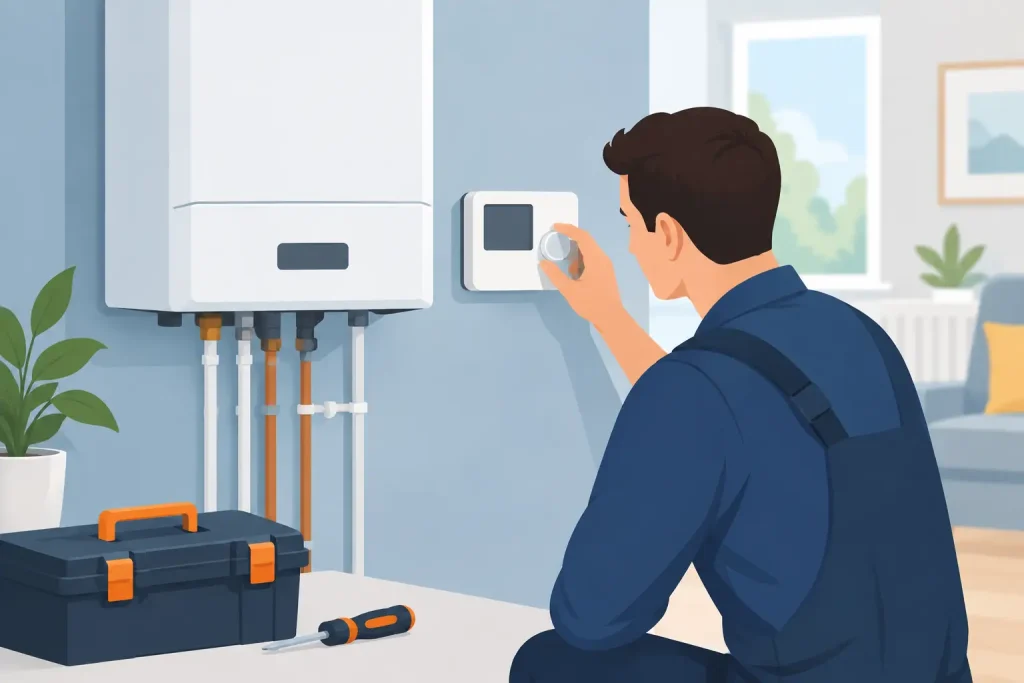
A cold home is rarely improved by turning the thermostat up to 30°C. If the heating still will not respond, this boiler thermostat troubleshooting guide helps you separate a simple setting or battery issue from a fault that needs a qualified engineer. A few safe checks can save time, especially when the problem appears suddenly on a busy morning or before tenants arrive.
Start with what the system is actually doing. Is the thermostat display blank? Does it show that it is calling for heat while the boiler remains silent? Are some radiators warm but the rooms never reach temperature? Those details make diagnosis far quicker and help avoid changing settings at random.
Boiler thermostat troubleshooting guide: start with safe checks
A thermostat controls when your boiler should provide heating. It does not create heat itself, so a thermostat that looks normal does not automatically prove that the boiler, receiver or heating controls are working correctly. Before touching anything, do not remove the boiler casing or interfere with gas components. Those checks are for a Gas Safe registered engineer.
First, make sure the boiler has electrical power and its display is on. Check whether it is showing a fault code, warning symbol or low-pressure message. Write the code down rather than repeatedly resetting the boiler, as repeated resets can mask a developing fault.
Then check that your heating programme is set to ‘on’, ‘auto’ at the correct time, or ‘manual’ where appropriate. It is common for a programmer to be left in holiday mode, an incorrect weekday schedule, or a timed-off period after a power cut. If you have separate controls for hot water and central heating, confirm that central heating is selected.
Set the thermostat a few degrees above the current room temperature. For example, if the room is 18°C, try 22°C. Give the system several minutes to react. Many boilers and smart controls have a short delay, so instant response is not always expected.
If the boiler fires and radiators begin warming up, the issue may have been a setting rather than a breakdown. Set the temperature back to a comfortable level once you have confirmed operation. Most households find around 18-21°C suitable, depending on the room and occupants.
Check the thermostat itself
A blank screen on a wireless thermostat is often caused by flat batteries. Replace them with the correct type, fitting them in the direction shown. Do not rely on a faint display alone: weak batteries can leave the screen working while preventing a reliable signal from reaching the boiler receiver.
For a wired thermostat, the display may be powered from the heating system rather than batteries. A blank or unresponsive wired control can point to a control fault, loss of supply to the heating controls, or an issue with the thermostat itself. Leave any wiring checks to a qualified engineer.
Look at the thermostat’s location too. A unit placed near a radiator, cooker, sunny window, draughty door or television can read the room temperature inaccurately. If it senses warmth from a nearby heat source, it may stop calling for heating before the rest of the room is comfortable. Moving a fixed thermostat is not a quick DIY job, but recognising the pattern is useful when arranging a repair.
Wireless and smart thermostat problems
Wireless thermostats communicate with a receiver, usually positioned close to the boiler. The thermostat may show a flame, radiator or ‘heating on’ symbol, while the receiver has not received the instruction. Check whether the receiver has a warning light or whether its normal indicator has changed colour or pattern.
A lost pairing can happen after battery changes, power interruptions or replacement controls. Some models allow safe re-pairing by following the manufacturer’s instructions. However, if you are unsure which buttons to use, avoid changing installer settings. Incorrect setup can leave the heating permanently off, permanently on, or unable to respond to its schedule.
Smart thermostats can add another layer of possible causes. Check that the app is not set to away mode, a reduced temperature schedule, geofencing, or a temporary override. Wi-Fi loss may affect app control, but it should not always stop local heating control. That depends on the model and how it was installed.
When the boiler and thermostat disagree
If the thermostat is demanding heat but the boiler will not fire, look at the boiler display. A pressure reading that is too low can stop many sealed systems from operating. The correct cold pressure varies by model, but it is often around 1 to 1.5 bar. Only repressurise the system if your boiler manufacturer’s instructions clearly explain how to do so and you are comfortable carrying out that specific step.
Pressure that keeps falling is not a normal thermostat issue. It may indicate a leak, a problem with the expansion vessel, or another system fault. Likewise, a boiler that repeatedly locks out needs professional attention rather than continual resetting.
If the boiler runs but radiators remain cold, the thermostat may be doing its job. The fault could instead involve trapped air, stuck radiator valves, a circulation issue, sludge in the system, or a diverter valve on a combi boiler. Notice whether every radiator is affected or just one area of the home. A single cold radiator points to a different investigation from a whole property with no heat.
If some rooms become far too warm despite the thermostat being satisfied, the receiver, zone valve or control wiring may be failing to stop the heating call. Turn the thermostat down and use the heating controls as intended, but arrange an engineer visit promptly if the boiler continues to run. Uncontrolled heating wastes energy and can make a property uncomfortable very quickly.
A practical fault checklist before you call
Taking a minute to collect the right information helps an engineer diagnose the fault efficiently. Have these details ready:
- The boiler make and model, if visible on the front panel.
- Any fault code, warning light or message on the boiler or receiver.
- Whether you have heating, hot water, both, or neither.
- Whether the thermostat is wired, wireless or app-controlled.
- What changed before the fault began, such as a power cut, battery replacement or pressure drop.
Also mention whether the issue is constant or intermittent. Heating that works only after several attempts, at certain times of day, or when the thermostat is moved can reveal a very different cause from a complete failure.
When to stop troubleshooting and call for help
Some faults should not be treated as a home troubleshooting job. If you smell gas, turn off the gas supply only if it is safe to do so, open doors and windows, avoid electrical switches and naked flames, and contact the National Gas Emergency Service on 0800 111 999. If a carbon monoxide alarm sounds, get everyone outside and seek urgent advice.
You should also call a qualified heating engineer if the boiler leaks, makes loud banging noises, shows recurring fault codes, loses pressure repeatedly, trips out, or will not respond after the safe checks above. Never remove the sealed boiler cover, as gas appliances must be inspected and repaired by an appropriately registered professional.
For homeowners, landlords and property managers, fast diagnosis matters as much as the repair itself. D C N Hinds Limited provides practical boiler diagnostics and repair support across North London and nearby areas, with clear advice on what has failed and the work needed to restore reliable heating.
A thermostat fault can be as small as a battery or programme setting, but it can also be the first visible sign of a wider heating problem. Check calmly, record what you see, and get qualified help before a small interruption turns into days without dependable warmth.
