
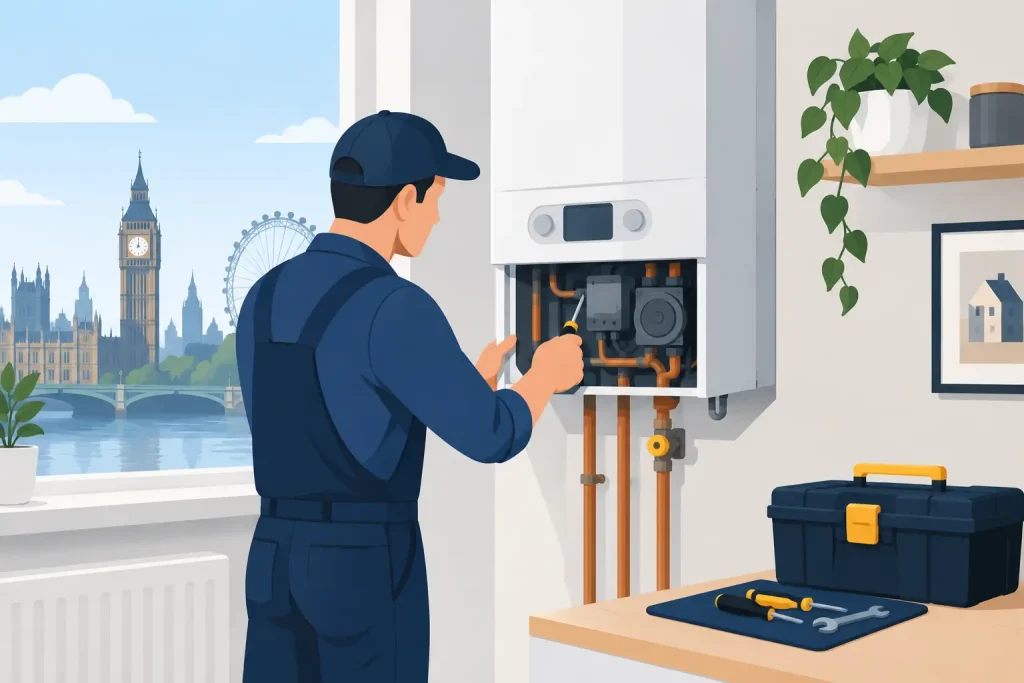
A boiler rarely fails at a convenient time. The first properly cold morning, a family weekend at home or the day a tenant moves in can quickly become stressful when there is no heating or hot water. This boiler maintenance checklist helps you spot basic warning signs early, keep your system running efficiently and know when to call a qualified engineer.
Some checks are safe for a homeowner or tenant to carry out. Anything involving the boiler casing, gas supply, combustion or internal components is not. Leave those jobs to a Gas Safe registered engineer.
Your boiler maintenance checklist at a glance
A few simple checks every month can prevent small issues being missed for weeks. They do not replace an annual boiler service, but they give you a clearer picture of how your heating is performing.
- Check that the boiler pressure is within the range shown in the manufacturer instructions, commonly around 1 to 1.5 bar when the system is cold.
- Look for drips, staining or corrosion around the boiler, visible pipework, radiators and the pressure relief pipe outside.
- Listen for new noises, such as banging, whistling, gurgling or persistent vibrating.
- Make sure the boiler’s vents and surrounding area are clear. Do not use the cupboard for coats, boxes or household storage.
- Test your heating and hot water before you depend on them, particularly before autumn and winter.
- Check that your carbon monoxide alarm is fitted in the correct place, has power and is within its stated replacement date.
If something has changed, do not wait for a complete breakdown before arranging a diagnosis. A boiler that still provides some heat may have a developing problem that is cheaper and quicker to address than an emergency failure.
Check boiler pressure without overcorrecting it
The pressure gauge is one of the most useful visible indicators on a sealed central heating system. If the reading is too low, the boiler may stop working or show a fault code. If it is too high, water may discharge from the pressure relief pipe and components can be put under unnecessary strain.
Check the operating range in your boiler manual, as the correct figure varies by model. A steady reading is generally reassuring. A pressure level that repeatedly drops is not something to ignore, even if topping it up gets the heating working again. It can point to a leak, a faulty expansion vessel or an issue with a valve.
You may be able to repressurise some boilers using the filling loop or built-in filling key, following the manufacturer’s instructions exactly. However, do not keep adding pressure as a routine fix. If the same issue returns, arrange for an engineer to investigate the cause.
Notice changes in heating and hot water
Your home gives useful clues when a boiler is losing efficiency. You may find that radiators take much longer to warm up, rooms heat unevenly, or hot water alternates between warm and cold. These symptoms can have several causes, including a boiler fault, trapped air in radiators, sludge in the system or a problem with controls.
Start by checking that the thermostat is set correctly and that the heating programme matches your household routine. If only one radiator is cold at the top, it may need bleeding. Take care to follow safe instructions, use the correct radiator key and never bleed radiators while the system is hot.
If several radiators are cold, there are brown marks around the boiler, or heating performance has gradually worsened, an engineer should assess the system. The right repair depends on the diagnosis. Simply increasing the boiler temperature or turning the thermostat higher can mask the issue while increasing energy use.
Pay attention to boiler noises
A boiler should make some operational noise, particularly when it starts and stops. Sudden or unusual sounds deserve attention. Banging can be associated with restricted water flow or system pressure problems. Gurgling may indicate air in the system. Whistling or kettling can occur when limescale or sludge affects the heat exchanger, especially in hard-water areas.
The sound alone is not a reliable diagnosis, so avoid removing panels or attempting internal repairs. Make a note of when the noise happens, whether an error code appears and whether heating or hot water is affected. This information helps an engineer get to the likely cause faster.
Keep the boiler area safe and accessible
Boilers need adequate ventilation and clear access for servicing and repairs. Never block vents, cover the boiler or store flammable items nearby. If the boiler is in a kitchen cupboard, keep cleaning products, aerosols and clutter away from it.
Take a moment to look at the condensate pipe too. This is usually a plastic pipe that carries acidic water away from a condensing boiler. During freezing weather, external condensate pipes can freeze and cause the boiler to shut down. A qualified engineer can advise on suitable protection if this has happened more than once.
You should also make sure the boiler’s controls are easy to reach. If a fault code appears, write it down or take a clear photograph of the display. Do not reset the boiler repeatedly. One reset may be permitted by the manufacturer, but repeated resets can delay a proper repair and, in some circumstances, may be unsafe.
Book a professional boiler service every year
An annual service is the part of boiler maintenance that should never be treated as optional. A Gas Safe registered engineer will inspect the boiler safely, test its operation, check for signs of wear or leaks, assess combustion where required and identify faults before they turn into a loss of heating or hot water.
A service is different from a repair. Servicing is planned preventative work on a boiler that is operating. A repair investigates a fault or failure. If your boiler has been unreliable, tell the engineer before the appointment so enough time can be allowed for diagnosis.
For homeowners, annual servicing is strongly recommended and may be required to maintain the manufacturer warranty. For landlords, a valid annual gas safety check is a legal responsibility for rented properties with gas appliances. Tenants should report boiler concerns promptly and allow access for safety checks and repairs.
In North London, arranging a service before the colder months can make practical sense. Demand for breakdown visits rises when temperatures fall, and a planned inspection gives you more choice than waiting until the system stops working.
Do not overlook carbon monoxide safety
Carbon monoxide is colourless and odourless, so you cannot rely on smell to detect it. A working audible carbon monoxide alarm provides an essential warning, but it does not replace professional servicing.
Possible symptoms of carbon monoxide exposure include headaches, dizziness, nausea, breathlessness, weakness and confusion. Symptoms that improve when you leave the property should be taken seriously. If you suspect carbon monoxide or a gas leak, turn off the appliance only if it is safe to do so, open doors and windows, leave the property and seek urgent advice. Do not use electrical switches, naked flames or appliances if you can smell gas.
A yellow or orange flame on a gas hob, black staining around an appliance, or a pilot flame that repeatedly goes out can also indicate that an appliance needs professional attention. Treat these as urgent warning signs rather than household jobs.
When to call for boiler repair
Call an engineer promptly if the boiler displays a persistent fault code, loses pressure repeatedly, leaks, makes loud unfamiliar noises or fails to provide reliable heating or hot water. The same applies if radiators remain cold after basic checks, or if the boiler keeps locking out.
D C N Hinds Limited provides responsive boiler diagnostics, servicing and repairs for households and rental properties across North London. Clear fault details, the boiler make and model, and any error code can help make the visit more efficient.
A well-maintained boiler is less likely to disrupt your day, but the goal is not to turn you into an engineer. Check what you can see safely, act on changes early and arrange qualified help when the system tells you something is wrong.
