
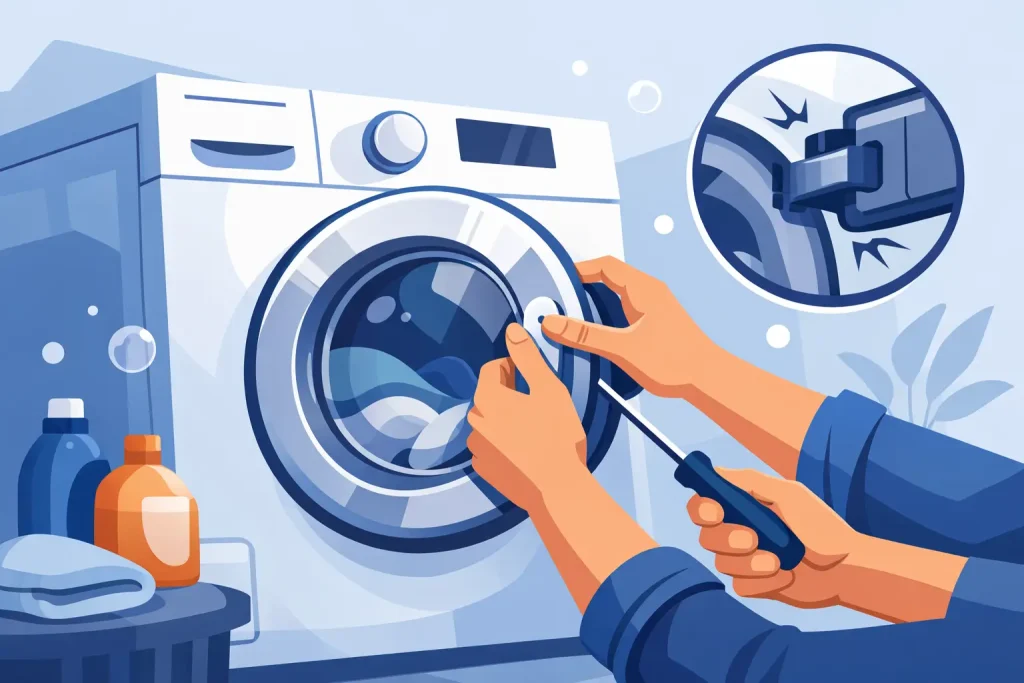
A load of washing finished hours ago, but the door will not release and the clothes are still inside. Before trying to force it, stop. Trying to open a jammed washing machine door by pulling the handle harder can break the handle, damage the door seal or release a large amount of water onto the floor.
Most locked doors have a sensible explanation: the machine may still detect water, the drum may be hot, the programme may not have ended properly, or the door interlock may have failed. A few careful checks can often identify the cause. If the door remains locked, a qualified appliance engineer can diagnose the fault and fit the correct part without causing further damage.
First, make sure it is safe to open
Do not attempt to open the door if you can see water behind it, the machine has stopped mid-cycle, or the drum and glass feel hot. Washing machines are designed to keep the door locked in these situations to prevent flooding and scalding.
Switch the appliance off at the socket and unplug it before inspecting anything beyond the controls. If the socket is difficult to reach, switch off the appropriate supply only if you can do so safely. Give the machine five to ten minutes after switching it off. Some door locks need a short period to release once the programme has ended and the power has been removed.
Avoid using screwdrivers, knives, wire hangers or force against the handle. These methods may release the catch, but they can also split the seal, snap the handle and turn a straightforward repair into a more expensive one.
How to open a jammed washing machine door safely
Start by checking the display and control panel. A child lock, control lock or delayed programme setting can make it appear that the washing machine has failed when it has not. The method for cancelling a child lock differs by make and model, but it commonly involves pressing and holding one or two marked buttons for several seconds. Your instruction manual will show the correct control combination.
If there is no child lock active, select a drain or spin programme and allow it to run. The machine will not normally unlock until it has drained fully. Listen for the drain pump and look through the glass to see whether water is still sitting at the bottom of the drum.
When the programme finishes, wait another two or three minutes before trying the door. Many machines keep the lock engaged briefly as a normal safety measure. Press the door in gently near the catch while pulling the handle once, rather than repeatedly yanking it. A little pressure can occasionally take strain off a sticking latch.
If the machine has frozen electronically, leaving it unplugged for around ten minutes may reset the controls. Reconnect it, choose drain or spin, and see whether it completes the cycle. This is worth trying once, but repeated resets will not fix a mechanical lock, a blocked pump or a drainage fault.
Check whether trapped water is the problem
A washing machine that cannot drain is one of the most common reasons for a locked door. The machine may have stopped because of a blockage in the filter, a blocked drain hose, a faulty pump or an issue with the drain connection. Even a relatively small amount of water may be enough for the appliance to keep the door locked.
Many front-loading machines have a filter access flap at the bottom front of the cabinet. Before opening it, place towels on the floor and use a shallow tray, as water may come out. Some models have a small emergency drain hose behind the flap, which lets you empty the remaining water in a controlled way. Follow the appliance manufacturer’s instructions for your model.
Once the water has been drained, the door may release after a short wait. Do not remove the filter if the water is hot. Leave the machine to cool first, and be prepared for more water than expected, especially after a full wash load.
If the filter is clear but the machine still will not drain, the fault may be with the pump, hose or an internal component. At that point, it is usually better to arrange a repair than continue dismantling the appliance. The obstruction could be deeper in the system, or the pump may have failed altogether.
Use the emergency release only if your model has one
Some washing machines have a manual emergency door release located behind the lower filter flap. It may be a coloured pull tab, a small lever or a cord. This is not fitted to every machine, and the exact position varies by manufacturer.
Only use an emergency release after the machine has been switched off and any water has been drained or confirmed absent. Pulling it while the drum is full can flood the room. If you cannot find a release in the manual, do not guess or pull on loose cables inside the machine.
An emergency release gets the door open, but it does not necessarily solve the underlying issue. If the machine repeatedly needs it, the interlock, drainage system or control fault still needs attention before the next wash.
Common faults behind a washing machine door that will not open
The door interlock is a frequent culprit. This is the safety mechanism that locks the door once a cycle starts and releases it at the end. It can wear out, stick internally or fail electrically. Typical signs include a clicking sound without release, an error message relating to the door, or a handle that feels normal but does not open the catch.
A broken door handle can produce similar symptoms. The handle may feel loose, move without resistance or fail to pull the internal catch. Forcing it is likely to cause more damage, particularly on plastic handle assemblies.
Drainage faults are another major cause. If water remains in the machine because of a blocked filter, obstructed hose or faulty pump, the appliance is doing what it is meant to do by keeping the door closed. A problem with the water-level sensor can also make the machine incorrectly believe that water is still inside.
Less commonly, a programme fault or control-board issue may leave the appliance locked after a completed cycle. It depends on the make, model and symptoms. A professional diagnosis avoids replacing parts on speculation.
When to call a washing machine repair engineer
Call for help if the machine will not drain, the door handle has broken, there is an error code, you smell burning, or the appliance trips the supply. Also arrange a repair if the door has stayed locked after the safe checks above and you cannot access a model-specific emergency release.
For tenants, it is sensible to report the fault promptly to the landlord or managing agent, particularly where water is trapped in the machine. Landlords and property managers should avoid asking occupants to force the door or dismantle panels, as this can complicate responsibility for damage.
D C N Hinds Limited provides responsive washing machine repairs for households across North London, with free quotations and an aim to attend the same day or next day where possible. An engineer can safely gain access to the drum, identify whether the fault is the lock, handle, pump or drainage system, and explain the repair required clearly.
A jammed door is frustrating, especially when you need school uniform, work clothes or towels. Keep the area dry, leave the machine switched off if there is any sign of a fault, and resist the temptation to force the catch. The quickest route back to normal is usually a safe check first, followed by the right repair rather than a damaged door and a flooded kitchen.
